Heart Palpitations During Workouts: Normal Adrenaline or a Warning Sign?
Quick Answer: Brief, occasional heart palpitations during intense exercise are usually a normal adrenaline and exertion response, but palpitations accompanied by chest pain, dizziness, fainting, or that persist well after you stop moving warrant prompt medical evaluation, not a wait-and-see approach.
You feel your heart flutter or skip during a hard set and immediately spiral into worry, unsure if it’s just exertion or something to actually be concerned about. That uncertainty is common, and there are real, learnable signals for telling the difference. This is general information, not medical advice — a genuine pattern of palpitations should be discussed with a doctor.

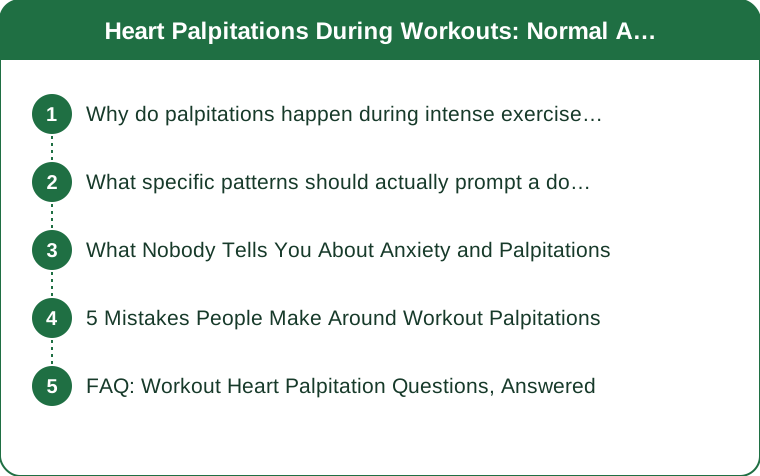
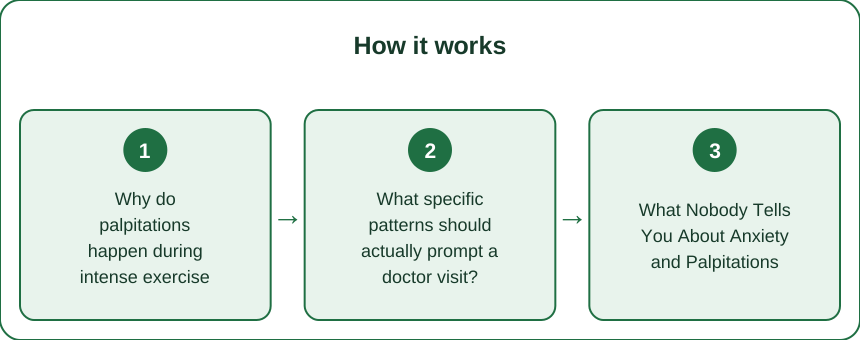
Why do palpitations happen during intense exercise in otherwise healthy people?
Intense exertion triggers a surge of adrenaline and increased sympathetic nervous system activity, which can cause the heart to briefly skip a beat or feel like it flutters, especially during maximal effort intervals or right after a heavy lift. This is a normal, common physiological response and doesn’t by itself indicate a heart problem in someone without other risk factors.
Dehydration, low electrolytes, excess caffeine before a workout, and poor sleep can all lower the threshold for these sensations, which is why the same person might notice palpitations more on some workout days than others without any underlying cardiac change.
What specific patterns should actually prompt a doctor visit?
Palpitations paired with chest pain, shortness of breath disproportionate to effort, dizziness, near-fainting, or palpitations that continue for several minutes after you’ve fully stopped moving are the patterns worth getting checked promptly, rather than assumed benign. A family history of heart conditions or unexplained fainting also raises the priority of getting evaluated.
A useful gut-check: occasional, brief flutters that resolve within seconds and don’t recur with rest are far less concerning than a pattern that’s new, worsening, or accompanied by other symptoms — the combination of symptoms matters more than the palpitation alone.

What Nobody Tells You About Anxiety and Palpitations
Workout anxiety itself, independent of actual heart rhythm changes, can produce a strong subjective sensation of a racing or skipping heart — meaning some palpitation experiences are more about heightened body awareness and nervous system activation than an actual measurable rhythm abnormality. This doesn’t mean the sensation isn’t real or worth understanding, just that anxiety and genuine arrhythmia can feel remarkably similar from the inside.
A simple heart rate monitor or fitness tracker recording during an episode can help a doctor distinguish between an actual rhythm event and a subjective sensation without one, which is useful information to bring to an appointment.
5 Mistakes People Make Around Workout Palpitations
1. Ignoring a new, recurring pattern because past instances turned out to be nothing.
2. Assuming youth or fitness level rules out any cardiac cause. Certain arrhythmias occur in fit young people too.
3. Pushing through a workout despite dizziness or chest discomfort to ‘finish the set.’
4. Not mentioning high caffeine or pre-workout supplement use to a doctor when describing symptoms.
5. Over-researching worst-case scenarios online instead of getting an actual evaluation, which increases anxiety without resolving uncertainty.
FAQ: Workout Heart Palpitation Questions, Answered
Are heart palpitations more common with high-intensity interval training specifically?
Some people do notice them more with HIIT-style efforts due to the rapid intensity spikes, though steady cardio and heavy lifting can trigger them too.
Can dehydration alone cause workout palpitations?
Yes — electrolyte imbalance from dehydration is a well-documented, generally benign cause of exercise palpitations in otherwise healthy people.
Should I stop exercising entirely if I’ve had a palpitation episode?
Not necessarily, but it’s reasonable to ease intensity and get evaluated before returning to your previous training intensity, especially if the episode included other symptoms.
TL;DR:
- Brief, isolated palpitations during intense exercise are usually a normal adrenaline response
- Chest pain, dizziness, fainting, or palpitations lasting after you stop are the patterns to get checked
- Anxiety itself can produce a strong palpitation sensation independent of actual rhythm changes
- This is general information, not medical advice — a recurring pattern deserves a real evaluation.
Keep Reading
This article is for general informational purposes only and is not medical advice. Always consult a qualified health professional for guidance specific to you.