Why Your Heart Rate Behaves Differently in the First Cool Week
Quick Answer: Heart rate at a given pace falls in cooler weather because less blood is diverted to the skin for cooling and plasma volume is under less strain. After a summer of training in heat, you also arrive at autumn with genuine adaptations — expanded plasma volume among them — that briefly make cool-weather running feel remarkably easy. The effect is real, partly temporary, and worth understanding before you rebuild your training zones around it.
This is general information, not medical advice.
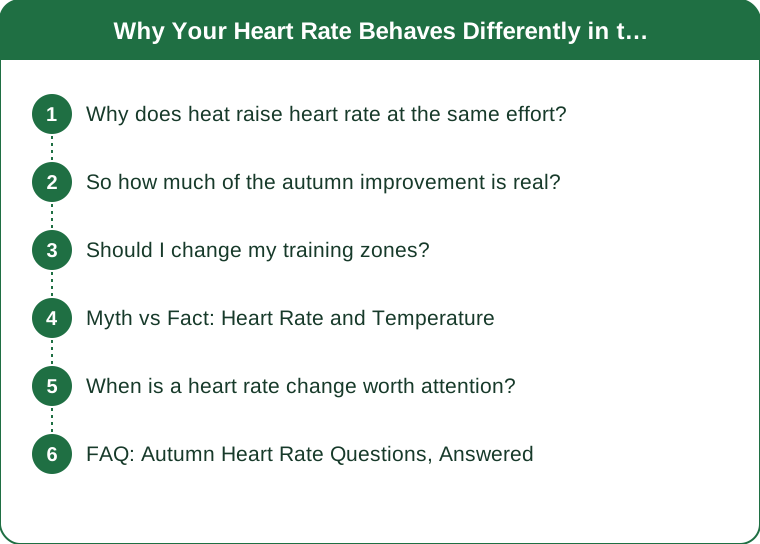
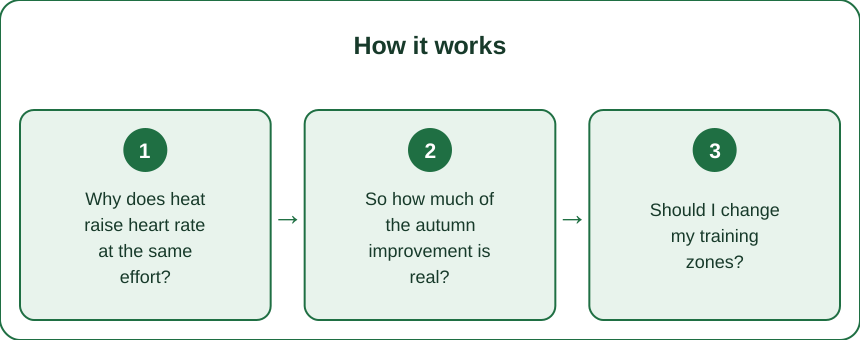
Why does heat raise heart rate at the same effort?
Blood gets shared between muscle and skin. Cooling requires blood flow to the skin surface, which reduces the volume available for returning to the heart, so heart rate rises to maintain the same output.
Sweat loss reduces plasma volume within a session. Less blood volume means less filling per beat, so the rate rises to compensate — this is cardiovascular drift, and it is the reason a steady effort produces a climbing heart rate on a hot day.
Humidity matters more than temperature. When sweat cannot evaporate, cooling fails and the skin blood flow demand rises further. A humid 26 degrees is harder than a dry 30.
The effect is large. Differences of 10 to 20 beats per minute at the same pace between a hot and a cool day are ordinary, not remarkable.
So how much of the autumn improvement is real?
Some of it genuinely is. Training through heat produces adaptations — increased plasma volume, earlier sweating onset, lower core temperature at a given workload — that persist for a few weeks and improve performance in cool conditions.
And some of it is just the weather. Removing the heat penalty makes the same fitness look better on paper.
Heat adaptations fade. They decay over roughly a week to a month without heat exposure, so a good part of the initial cool-weather boost is temporary.
The fitness you actually built over summer stays. Separating the three is not really possible in the moment, which is why it is worth waiting a few weeks before concluding anything about your zones.
Should I change my training zones?
Not on the first cool week. Give it two to three weeks of stable conditions before retesting.
If you do retest, retest, do not estimate. A field test in similar conditions to your normal training beats adjusting numbers based on how a few runs felt.
Run by effort during the transition. Perceived exertion handles temperature changes automatically; fixed heart rate zones do not.
Watch the pace, not just the heart rate. The most common autumn mistake is running easy days faster because the heart rate permits it, which quietly turns the easy volume into moderate volume.
Expect the change to be uneven. A cool morning followed by a warm afternoon produces two different sets of numbers in the same week, and that is the weather rather than you.
Myth vs Fact: Heart Rate and Temperature
Myth: A lower heart rate at the same pace always means improved fitness. Fact: Temperature, hydration, sleep, caffeine, and stress all move it. Fitness is one input among several.
Myth: Cardiovascular drift means you are unfit. Fact: Everyone drifts. The magnitude relates to heat, hydration and duration more than to fitness level.
Myth: Training in heat is wasted time. Fact: Heat training produces genuine adaptations that transfer to cool conditions. Summer training is not a write-off; it is an investment that pays out in September.
Myth: Resting heart rate should fall in autumn too. Fact: It often does slightly, but resting heart rate is dominated by sleep, illness and stress. A single low morning reading means very little.
Myth: Wrist heart rate is accurate enough to detect these differences. Fact: Wrist optical sensors are least accurate in cold weather and during intensity changes, precisely the conditions of an autumn transition. A chest strap is worth using if the numbers matter to you.
When is a heart rate change worth attention?
A resting heart rate elevated by more than about 5 to 10 beats for several consecutive days, without an obvious cause like illness or alcohol, is worth noting.
Heart rate that will not settle after exercise — staying substantially elevated well beyond the usual recovery window — is a reason to back off and, if it persists, to seek advice.
Palpitations, chest discomfort, unusual breathlessness, dizziness or fainting during or after exercise need medical assessment. These are not training-load questions.
A sudden inability to reach your usual heart rate at hard effort is also worth mentioning to a doctor, particularly after an illness.
Everything else in this article is normal seasonal variation. The point of understanding it is to stop reading weather as either fitness or a problem.
FAQ: Autumn Heart Rate Questions, Answered
How long until my heat adaptations disappear?
Most fade over one to four weeks without heat exposure. Some markers persist longer than others, and re-adapting the following summer is faster than the first time.
Should I keep some heat training through autumn?
Only if you have a specific reason, such as a warm-weather race. Otherwise it is not necessary and adds fatigue.
Why is my heart rate high on cold mornings specifically?
Very cold air causes peripheral vasoconstriction and a modest rise in blood pressure and heart rate at rest and in early exercise. A longer warm-up smooths it out.
TL;DR:
- Heat raises heart rate at a given pace by diverting blood to the skin and reducing plasma volume.
- Cool weather removes that penalty, so numbers improve immediately and partly artificially.
- Summer heat training also produces real adaptations, which fade over one to four weeks.
- Wait two to three weeks of stable weather before retesting zones, and run by effort meanwhile.
- Persistent resting elevation, chest symptoms or dizziness are medical questions, not training ones.
The first cool week flatters everyone. Enjoy it, then check the numbers in October.
This is general information, not medical advice.
Keep Reading
This article is for general informational purposes only and is not medical advice. Always consult a qualified health professional for guidance specific to you.