Why Your Heart Rate Numbers Change When Training Moves Indoors
Quick Answer: When training moves indoors at the end of summer, heart rate at the same pace usually drops by roughly 5 to 12 beats per minute outdoors in cooler air, but stays stubbornly high indoors - and the reason is air movement, not fitness. Outdoor air flowing past you removes heat by convection; a still indoor room does not, so your body keeps sending blood to the skin to cool itself and the heart compensates with rate. On top of that, the plasma volume you built over a hot summer starts reversing within one to two weeks of cooler training, which temporarily raises heart rate at any given pace. Both settle. Neither means you lost fitness.
You moved the treadmill sessions inside, or the studio reopened, or it finally stopped being 90 degrees at 6pm. And the number on your watch stopped making sense.
Same pace, same perceived effort, a different heart rate - and it is going in a direction you did not expect.

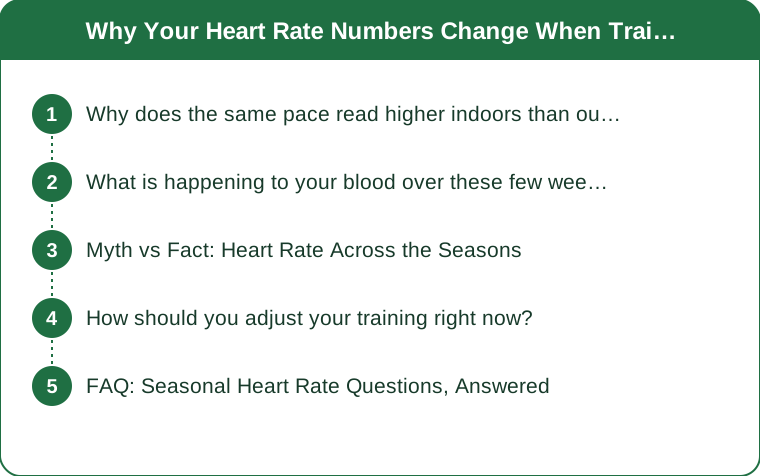
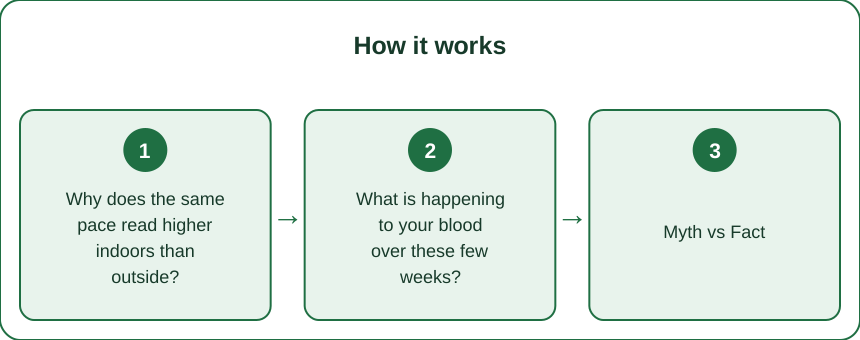
Why does the same pace read higher indoors than outside?
Because still air is a much worse cooling system than moving air, and heart rate pays for the difference.
When you exercise, most of the energy you produce becomes heat. The body sheds it two main ways: evaporating sweat, and moving warm blood to the skin where it can lose heat to the surrounding air. That second route costs you cardiac output - blood sent to the skin is blood not sent to working muscle, so the heart raises rate to cover both jobs.
Outdoors, you generate airflow simply by moving through the air. That convective cooling is substantial, and it is why the same run on a treadmill in a still room feels considerably harder than the same run outside at the same temperature. Put a fan in front of a treadmill and a meaningful part of the difference disappears.
Indoor studios add another factor: humidity rises in a room full of people exercising, and humid air slows sweat evaporation. Sweat that drips rather than evaporates has cooled you very little while still costing you fluid.
The practical size of the effect is not small. Comparing an outdoor effort in moving air with the same effort indoors in still air, differences of five to fifteen beats per minute at matched pace are common and entirely normal.
So the reading is not wrong and your fitness has not moved. The cooling environment changed, and heart rate is partly a thermoregulation number, not purely an effort number. That is worth internalizing, because it explains most seasonal confusion about heart rate data.
What is happening to your blood over these few weeks?
You are losing the plasma volume that a hot summer built, and that alone moves heart rate.
Heat acclimatization is a real and measurable adaptation. Across roughly one to two weeks of repeated heat exposure, the body expands plasma volume - the liquid portion of blood - by a meaningful margin. More plasma means more blood volume, which means the heart moves more blood per beat, which means a lower heart rate at any given workload.
That is why late summer often feels unexpectedly good: you spent June and July paying for an adaptation and by August you were collecting on it.
The reversal is faster than the adaptation. When heat exposure stops, plasma volume begins returning toward baseline within days, and much of the gain is gone inside a couple of weeks. Stroke volume drops slightly, and heart rate at the same pace rises to compensate.
So there is a genuine window - usually the second and third week after training conditions cool - where your heart rate is higher at a given pace and nothing is wrong. It is the acclimatization unwinding, not a decline.
The confusing part is that these two effects point in opposite directions, which is why the data looks noisy. Cooler outdoor air lowers heart rate at the same pace. Losing plasma volume raises it. Moving indoors into still air raises it further. Depending on which dominates in a given week, your numbers can go either way.
This is also why comparing a September session directly against an August session is close to meaningless. Compare within a season, not across the transition.

Myth vs Fact: Heart Rate Across the Seasons
Myth: A lower heart rate at the same pace always means improved fitness. Fact: It can also mean cooler air, better hydration, a different surface, more airflow, or simply less accumulated fatigue. Fitness is one input among many. A single autumn week of lower numbers is weather before it is progress.
Myth: If my heart rate is higher, I should slow down. Fact: Sometimes yes - but if perceived effort is unchanged and only the number moved, the number is reflecting cooling and blood volume rather than metabolic cost. Train by feel through the transition and let the data resettle before you rewrite your paces.
Myth: Heart rate zones set in summer carry over to autumn. Fact: Zones anchored to a threshold test done in heat are frequently a few beats off once the season changes. Retest in the conditions you will actually train in, and expect to retest again in deep winter.
Myth: Treadmill and outdoor heart rate should match at the same pace. Fact: They rarely do. Still air, no wind resistance, belt assistance, and a fixed gradient all differ. Matching effort rather than pace is the only reliable comparison between the two.
How should you adjust your training right now?
Give the data two to three weeks, keep hydrating, and retest instead of guessing.
Train by perceived effort through the transition. For the two to three weeks that plasma volume is unwinding, use rate of perceived exertion and breathing as the primary guide, with heart rate as a secondary check. This is the single change that prevents most transition-week frustration.
Do not stop hydrating because it got cooler. Thirst drive drops noticeably in cool weather while sweat losses stay significant, especially indoors in still air. Under-hydration raises heart rate directly - a few percent of body mass lost as fluid is enough to add several beats per minute at the same workload - and it is the most common reason autumn heart rate stays elevated longer than it should.
Add airflow indoors. A fan on a treadmill or bike is not a comfort item; it restores part of the convective cooling you lost, and it will lower heart rate at the same pace.
Retest your threshold after three to four weeks, once conditions have stabilized. Zones built on a July test will misdirect an October training block.
And watch resting heart rate rather than session heart rate if you want a cleaner fitness signal through the changeover. Measured at the same time each morning, it is far less contaminated by ambient conditions.
A resting heart rate that has climbed and stayed up for more than a week, especially with poor sleep or unusual fatigue, is worth attention rather than dismissal. This is general information, not medical advice - chest discomfort, unexplained breathlessness or an irregular rhythm should go to a clinician, not a forum.
FAQ: Seasonal Heart Rate Questions, Answered
How long until my heart rate settles at the new normal?
Usually two to three weeks. The plasma volume gained in summer heat reverses over roughly that window once heat exposure stops, and after that your numbers at a given pace stabilize. If it has been over a month and heart rate is still elevated at easy efforts, look at sleep, hydration and cumulative training load before you look at fitness.
Should I use a chest strap instead of my watch for this?
If you are trying to compare across conditions, yes. Optical wrist sensors are more affected by cool skin, reduced peripheral blood flow and strap tightness - all of which change as the weather cools. A chest strap removes a variable that gets worse in exactly the season you are trying to measure.
Why is my heart rate lower outdoors in the cold but I feel worse?
Cold air constricts peripheral vessels and shifts blood centrally, which can lower the number while the session genuinely feels harder because muscles are cold, warm-up takes longer, and breathing cold dry air is uncomfortable. Extend your warm-up considerably in cool weather and judge the session by the middle, not the first ten minutes.
TL;DR:
- Still indoor air removes far less heat than moving outdoor air, so heart rate rises at the same pace - a fan recovers part of it.
- The plasma volume built over a hot summer reverses within one to two weeks, temporarily raising heart rate at any workload.
- Those two effects push in opposite directions, which is why the transition data looks contradictory.
- Train by perceived effort for two to three weeks, then retest your threshold in current conditions.
- Keep hydrating - thirst drops in cool weather while sweat losses do not, and dehydration adds beats directly.
- Resting heart rate is the cleaner fitness signal during the changeover than session heart rate.
This is general information, not medical advice. The number moved because the environment did.
Keep Reading
This article is for general informational purposes only and is not medical advice. Always consult a qualified health professional for guidance specific to you.