Why Your Heart Rate Runs Higher in Summer and What It Actually Means
Quick Answer: In heat, your body sends blood to the skin to shed heat, which leaves less returning to the heart per beat. The heart compensates by beating faster — commonly 10 to 20 bpm higher at the same pace, and more as a session goes on. This is cardiac drift, it’s a normal thermoregulatory response, and it means heart rate is a less reliable intensity guide in summer than in cool weather. It’s not a sign of lost fitness, and it usually resolves within days of cooler conditions.
Your easy pace in April sat at 138 bpm. The same pace in August reads 155 and climbs through the run.
Everything about that is expected, and the mistake people make is either ignoring it or panicking about it.

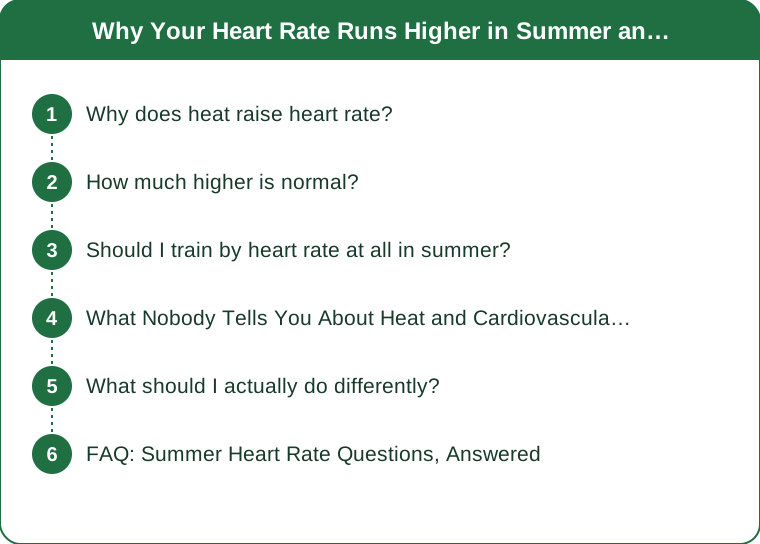
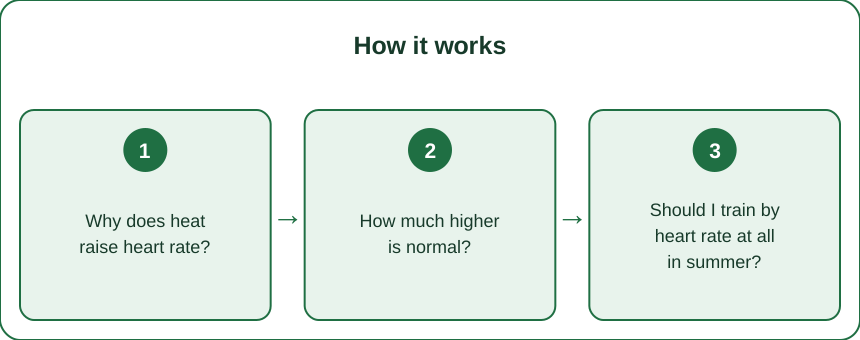
Why does heat raise heart rate?
Because cooling and circulating are competing for the same blood, and cooling wins.
Working muscle needs blood for oxygen. Skin needs blood to release heat. In cool conditions there’s plenty to go around. In heat, a substantial fraction of cardiac output is diverted to the skin, and the muscles have to be served with what’s left.
Sweating reduces plasma volume, which means less blood returning to the heart with each beat — lower stroke volume. The only way to maintain the same total output is to beat more often. That’s the mechanism, and it’s straightforward.
Cardiac drift is the same effect over time. As a session continues, you lose more fluid and your core temperature rises, so heart rate climbs steadily even at a completely unchanged pace. A drift of 5 to 15 bpm across an hour in heat is normal.
Dehydration amplifies everything. A 2% loss of body weight in fluid raises heart rate by roughly 8 to 10 bpm at the same workload.
Humidity makes it worse than temperature alone suggests, because sweat that doesn’t evaporate doesn’t cool you — so you get the fluid loss without the benefit.
How much higher is normal?
10 to 20 bpm at the same pace is typical. Above that, other factors are usually involved.
At 75 to 80°F, expect roughly 5 to 10 bpm above your cool-weather rate at the same effort. At 85°F+ with humidity, 15 to 20 bpm is unremarkable.
Cardiac drift adds another 5 to 15 bpm over the course of a long session, so an easy run that starts at 145 and finishes at 158 is behaving exactly as expected.
Your resting heart rate also rises in summer — commonly 3 to 7 bpm — for the same circulatory reasons plus poorer sleep in warm rooms. This is why a fitness tracker may report worse recovery scores all summer.
What isn’t normal: a heart rate more than 25 bpm above expected at easy effort, a rate that doesn’t come down within a few minutes of stopping, or one accompanied by dizziness, nausea, chills, or confusion. Those are heat illness signals and warrant stopping immediately. This is general information, not medical advice — new or unexplained heart rate changes deserve a conversation with a clinician.
A useful reference point: track your morning resting heart rate. If it’s up 10+ bpm for several days running, you’re accumulating heat and fluid stress rather than adapting to it.
Should I train by heart rate at all in summer?
Use it as a ceiling, not a target. Effort becomes the primary guide.
The problem with a heart rate target in heat is that it makes you run slower and slower to hold a number that the environment has inflated. You end up walking to keep an ‘easy’ zone that has nothing to do with metabolic intensity.
Use talk test instead for easy runs. Full sentences comfortably = easy. That’s a metabolic measure and heat doesn’t distort it.
Use RPE for harder work. A 1 to 10 scale, where threshold work sits at 7 to 8. Your perception adjusts to conditions in a way that a fixed bpm target cannot.
Where heart rate stays useful: as an upper limit. Setting a cap — ‘don’t exceed 165 on easy days’ — protects against the accumulated strain of running hard in heat without turning the number into the goal.
Compare like with like. A heart-rate-to-pace comparison is only meaningful between runs in similar conditions. Comparing an 82°F August run to a 55°F April run tells you about the weather, not your training.
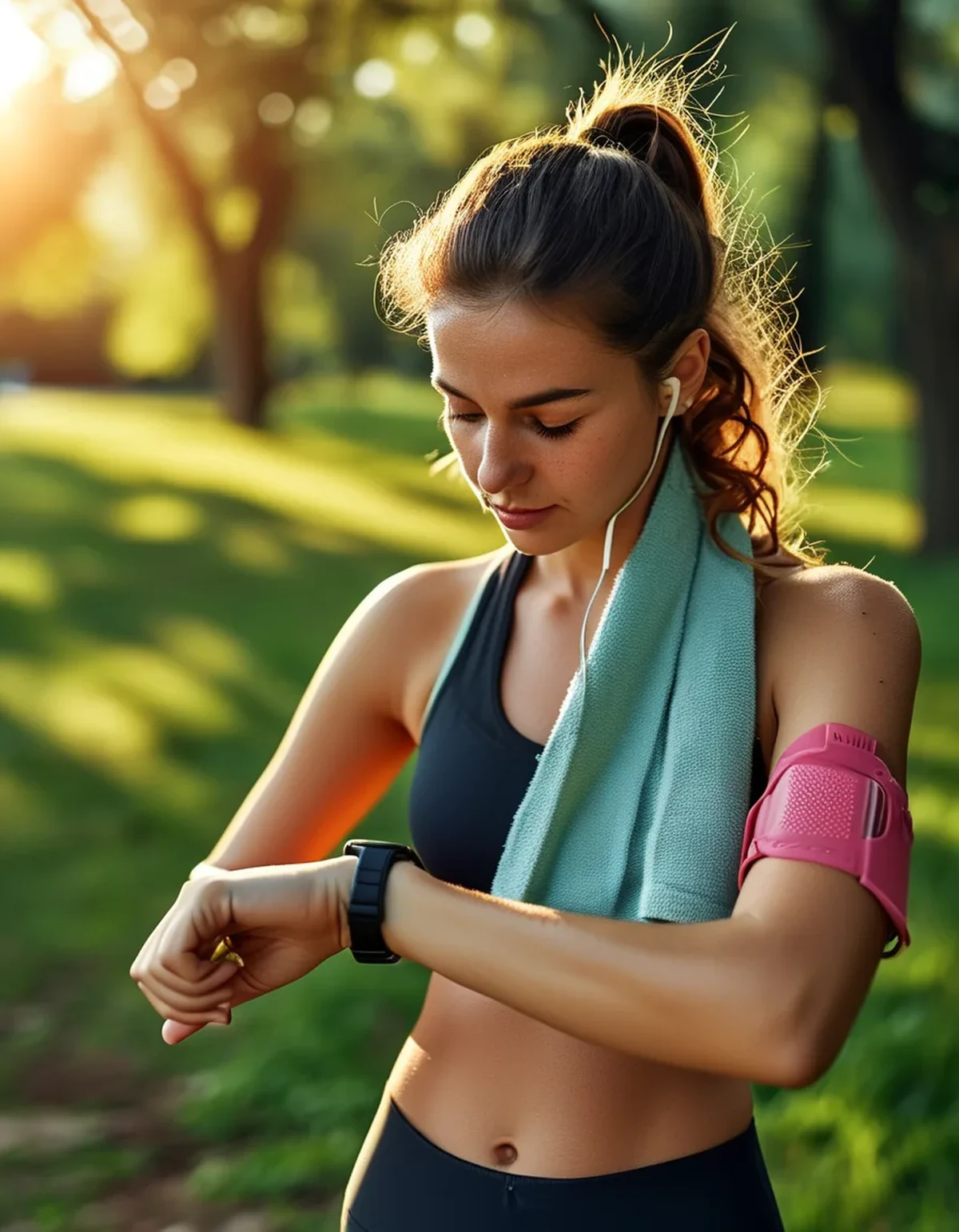
Wrist optical sensors get less accurate in heat too — sweat, skin blood flow changes, and motion all degrade the signal. A chest strap is meaningfully more reliable in exactly the conditions you most need reliability.
What Nobody Tells You About Heat and Cardiovascular Fitness
Training in heat produces adaptations that look a lot like altitude training, and they carry over to cool weather.
Plasma volume expands by 4 to 15% within one to two weeks of consistent heat exposure. That’s more blood, better stroke volume, and better cardiac efficiency — benefits that persist when the weather cools.
Your heart rate at a given pace drops as acclimation develops. If you compare week one of a heat block to week three at similar conditions, a 5 to 10 bpm reduction is a direct measure of adaptation. This is one of the few times you can watch a physiological adaptation happen in real time.
Sweat becomes more dilute — your body conserves sodium as you acclimate — which means less electrolyte loss for the same cooling.
Core temperature at which you start sweating drops, so cooling begins earlier in a session.
The catch: it fades fast. One to two weeks without heat exposure and most of it is gone. This is why athletes doing deliberate heat training keep some exposure through a taper.
And the part that surprises people most: the fitness you build in a hot summer often doesn’t show up until the first cool week of autumn, when the handicap is removed and the adaptations remain. A lot of personal bests happen in the first three weeks of genuinely cool weather.
What should I actually do differently?
Four changes, all small.
Hydrate ahead rather than catching up. 500ml in the two hours before a session and sipping throughout does more than drinking a lot afterward. Pale yellow urine is the practical check.
Add sodium for anything over an hour. 300 to 700mg per hour in heat. Water alone during heavy sweating dilutes blood sodium, which is both a performance and a safety issue.
Pre-cool when you can. A cold drink or a cold towel on the neck before starting measurably lowers the heart rate response for the first portion of a session. Ice in the water bottle is a legitimate performance intervention, not a comfort one.
Shift the time, not just the intensity. Dew point is the number to check — above 65°F is when most people feel the disproportionate difficulty. Early morning has both the lowest temperature and the lowest radiant load.
Give yourself an extra easy day in the hottest weeks. Heat is a training stress on top of the training stress. A plan written without accounting for it will overreach you by late August, and that’s what turns a good summer into a disappointing autumn.
FAQ: Summer Heart Rate Questions, Answered
Has my fitness actually gone backwards?
Almost certainly not. Heat inflates heart rate at every intensity. The honest test is one workout on the first cool morning of autumn — most people find their fitness is better than the summer numbers suggested.
How long does heat acclimation take?
Meaningful adaptation in 10 to 14 days of regular exposure, with most of the plasma volume change happening in the first week. It fades within one to two weeks without continued exposure.
Why is my resting heart rate higher all summer?
Higher ambient temperature, ongoing mild dehydration, and disrupted sleep in warm rooms all contribute. A rise of 3 to 7 bpm through summer is common and reverses in autumn.
Should I take electrolyte drinks for a 45-minute workout?
Generally not necessary — water is fine under an hour unless you’re an exceptionally heavy or salty sweater. Past an hour in heat, sodium becomes genuinely useful.
When should I stop a workout and seek help?
Chills or goosebumps in heat, stopping sweating, confusion, severe headache, nausea, or a heart rate that stays high after several minutes of rest. These are heat illness signals, not toughness tests.
This is general information, not medical advice.
TL;DR: A higher summer heart rate is your cooling system working, not your fitness failing.
- Blood diverts to the skin to shed heat, stroke volume drops, and the heart compensates by beating faster.
- 10 to 20 bpm higher at the same pace is normal, plus 5 to 15 bpm of drift across a long session.
- 2% fluid loss adds 8 to 10 bpm on its own — hydration is the biggest controllable variable.
- Train by effort and talk test in summer; use heart rate as a ceiling rather than a target.
- Heat acclimation expands plasma volume 4 to 15% in two weeks and carries into cool weather.
- Know the stop signals: chills, stopping sweating, confusion, or a rate that won’t come down.
Track your morning resting heart rate through the rest of August. If it drifts up 10+ bpm for several days, that’s your signal to back off — and it’s a far better indicator than any single run’s numbers.
Keep Reading
This article is for general informational purposes only and is not medical advice. Always consult a qualified health professional for guidance specific to you.