How Long Your Heart Rate Takes to Normalize After Summer Heat Ends
Quick Answer: Most heat adaptations fade in 2 to 4 weeks once you stop training in the heat, and they fade unevenly. Plasma volume, which is what lowered your heart rate at a given pace, drops off first and fastest, often within 8 to 14 days. Sweat rate and sweat sodium changes hang on longer. So the first cool weeks can feel great, and then somewhere in week three your heart rate at the same effort creeps back up. That is normal de-acclimatization, not lost fitness.
The first genuinely cool morning of the season is a gift. You run your usual loop and your watch shows a heart rate ten beats lower than it has been since June.
Then three weeks later, same loop, same cool air, and the number is back up. Nothing about your training changed. Something about your blood did.

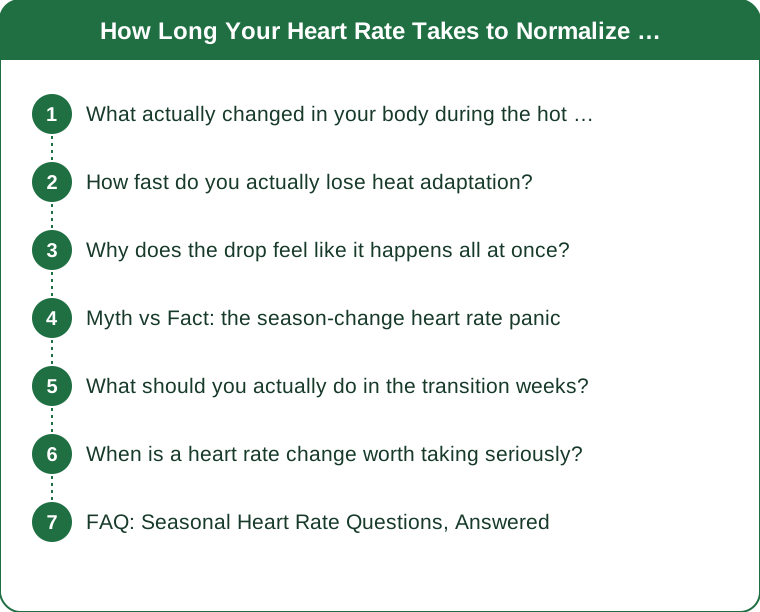
What actually changed in your body during the hot months?
Training in heat forces a specific set of adaptations, and the biggest one is not in your heart at all. It is in your plasma, the liquid part of your blood.
After about 5 to 10 days of repeated heat exposure, plasma volume expands by roughly 4 to 15 percent. More liquid in circulation means each heartbeat moves more blood, which means your heart does not have to beat as often to deliver the same oxygen. This is why heat training is sometimes described as a poor woman’s altitude camp.
Alongside that, you start sweating earlier, sweating more, and losing less sodium in each drop of sweat. Your skin blood flow gets smarter about dumping heat. Your core temperature at a given workload settles a bit lower.
The important part: those adaptations are maintenance-dependent. Your body built them because you kept asking for them. When the asking stops, the accounting department starts reclaiming resources.
How fast do you actually lose heat adaptation?
The research is reasonably consistent, and the ranges are wider than most people expect.
- Plasma volume: starts decaying within 3 to 5 days of no heat exposure, largely gone by 2 to 3 weeks.
- Heart rate benefit at a given workload: fades on a similar curve, usually 60 to 80 percent lost by day 14 to 21.
- Sweat rate and sweat onset: more durable, often holding partial benefit for 3 to 4 weeks.
- Sweat sodium conservation: the most stubborn, sometimes measurable past a month.
The practical version: you keep the adaptation for roughly half as long as it took to build it. Two weeks to acclimate usually means two to four weeks to decay.
That is also why the timing feels confusing. The cool air masks the loss for the first stretch, because cool air itself lowers your heart rate. Once the novelty of the temperature drop stops offsetting the plasma decline, the number climbs back and it feels like it happened overnight.
Why does the drop feel like it happens all at once?
Two curves are moving in opposite directions at the same time and you only see the sum.
Curve one: ambient temperature falls, which lowers cardiovascular strain immediately. Every degree cooler is fewer beats spent on skin cooling.
Curve two: plasma volume falls, which raises heart rate at a given pace.
In the first week, curve one is winning by a lot and you feel superhuman. By week three, curve one has mostly finished its move, temperatures have stabilized in the new range, and curve two is still declining. The sum flips sign.
Nothing broke. You are just seeing the second curve without the first one hiding it. If you had a heart rate log from mid-May, you would probably find that your current numbers are close to that baseline.

Myth vs Fact: the season-change heart rate panic
Myth: a higher heart rate at the same pace means you lost fitness. Fact: fitness lives mostly in your muscles, mitochondria, and capillaries, and none of those decay in two weeks of normal training. Plasma volume is a fluid state, not a fitness state.
Myth: you should train harder to fix it. Fact: chasing an old heart rate number by pushing pace is the fastest way to turn a normal fluid shift into actual fatigue.
Myth: you can prevent the loss by drinking more water. Fact: plasma expansion is driven by hormonal signaling from repeated heat stress, not by intake volume. Drinking extra water without the heat stimulus just means more trips to the bathroom.
Myth: it happens the same way for everyone. Fact: people who trained in heat for 6 or more weeks hold adaptations noticeably longer than people who did 10 days. Length of exposure predicts durability.
What should you actually do in the transition weeks?
Do less measuring and more anchoring to effort.
Switch your primary gauge to perceived effort for 3 to 4 weeks. Run your easy runs at conversational pace and let the heart rate be whatever it is. You are between two valid baselines, so neither one is a fair yardstick.
Re-test on a fixed protocol once things settle. Around week four of consistent cool weather, do the same 20-minute effort on the same route at the same time of day. That number becomes your new fall baseline.
Do not chase pace. If your usual easy pace now costs 8 more beats, run 15 to 20 seconds per mile slower and keep the effort honest. Pace will come back as the season’s own adaptations build.
If you want to keep some heat adaptation, two sauna sessions per week of 15 to 20 minutes post-workout will hold a portion of the plasma benefit. Whether that is worth it depends entirely on whether you have a heat-relevant goal coming up.
When is a heart rate change worth taking seriously?
Seasonal drift is gradual, effort-linked, and pace-linked. Some things are not, and those deserve attention rather than patience.
Worth a conversation with a clinician:
- Resting heart rate up more than 10 beats for over a week with no training change
- Heart rate that spikes disproportionately at very low effort, like walking
- New shortness of breath, chest discomfort, dizziness, or fainting with exertion
- A racing or irregular sensation that does not track with effort at all
- Heart rate that will not come down in the 10 minutes after you stop
Seasonal de-acclimatization does not cause symptoms. It causes numbers. If you have symptoms, the season is not the explanation.
This is general information, not medical advice.
FAQ: Seasonal Heart Rate Questions, Answered
How long does heat acclimatization last after summer?
Most of the cardiovascular benefit fades in 2 to 4 weeks without heat exposure. Sweat-related adaptations last longer, sometimes past a month. Longer heat training blocks decay more slowly than short ones.
Is my heart rate higher in cold weather or lower?
Usually lower at a given pace in mild cool weather, because less blood is diverted to your skin. In genuinely cold conditions it can rise again from shivering, vasoconstriction, and heavier clothing.
Should I redo my heart rate zones for fall?
Yes, but wait. Re-test after about four weeks of stable cool-weather training, so you are measuring a settled state instead of a moving one.
TL;DR:
- Summer heat training expanded your plasma volume, which is what lowered your heart rate at a given pace.
- That adaptation decays in roughly 2 to 4 weeks once the heat stops, faster than most people expect.
- The first cool weeks feel amazing because falling temperature temporarily masks the falling plasma volume. Week three is when the mask comes off.
- Train by effort for a month, then re-test on a fixed route to set an honest fall baseline.
The number on your wrist is describing your blood, not your ability. Give it a month of consistent cool-weather work and the fall version of your fitness will show up with numbers of its own.
Keep Reading
This article is for general informational purposes only and is not medical advice. Always consult a qualified health professional for guidance specific to you.